From Assisting Organist, Rich Spotts
Today’s Gospel from Saint Matthew exhorts humanity to “let your light so shine before men, that they may see your good works.” The idea of “light” was first presented to us this past week on February second with the Feast of Candlemas, which cites the “Nunc dimittis” where it references Christ as “the Light to lighten the gentiles.” Therefore, since we are within the octave of Candlemas, today’s prelude and postlude will expand upon this theme.
The fortieth day after Christmas is the Feast of Candlemas, also known as the Presentation of Christ in the Temple or the Purification of Mary. Like All Saints in November, Candlemas is a cross-quarter feast marking the halfway point between seasons (winter and spring). Ceremonially, it is known for the blessing and lighting of candles in recognition of the text for the day, “a light to lighten the Gentiles” (hence the feast’s name).
According to ancient Jewish custom, forty days after giving birth, new mothers would present themselves at the Temple in Jerusalem to be ritually purified. In the New Testament account found in the Gospel of Saint Luke, Mary, Joseph, and the Christchild are recorded following this custom, offering two turtle doves as a sacrifice. There, the Holy Family happened upon the prophet Simeon, who, in a vision, was told “that he should not see death before he had seen the Lord’s Christ.” Upon seeing Jesus, according to tradition, Simeon, in his ecstasy, recited what has become known as the “Nunc dimittis”, a canticle which is now sung at Evensong and Compline services to this day: “Lord, now lettest thou thy servant depart in peace: according to thy word For mine eyes have seen thy salvation: which thou hast prepared before the face of all people; to be a light to lighten the Gentiles: and to be the glory of thy people Israel.”
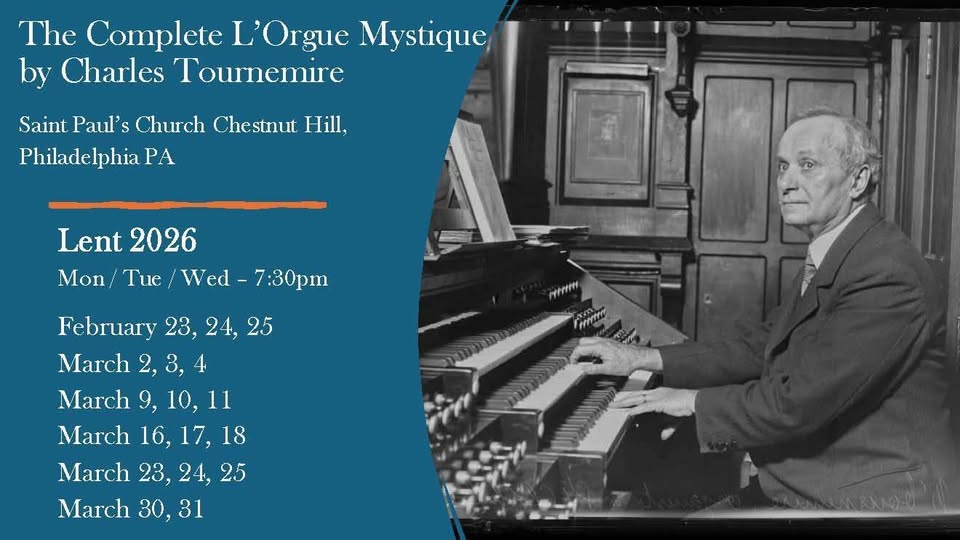
Today’s prelude is the Candlemas Suite from “L’Orgue Mystique” by the French composer Charles Tournemire (1870–1939). The liturgical propers for the day vividly recount and celebrate this prophetic moment: The Prélude à l’introït: “We wait for thy loving-kindness, O God: in the midst of thy temple.” (Psalm xlvij/xlviij); the Offertoire: “Full of grace are thy lips: because God hath blessed thee for ever, and world without end.” (Psalm xliv/xlv); the Élévation: “And when his parents brought in the Child Jesus, then Simeon took him up in his arms, and blest God, saying, Lord, now lettest thou thy servant depart in peace.” (Saint Luke ij); and the Communion: “It was revealed unto Simeon by the Holy Spirit, that he should not see death, before he had seen the Lord’s Anointed.” (Saint Luke ij).
The final movement of this suite—“Diptyque”—is a tone poem based upon the Gospel account. In the beginning, one hears the agèd Simeon at vigil in the Temple. As he hobbles through the Temple precincts (depicted through a rhythmic pattern in the organist’s feet), Simeon happens upon the Christchild and offers his acclamation. The “hobbling theme” returns—this time ornamented with a soaring flute conveying Simeon’s sense of elation—as the work draws to a serene conclusion.
Today’s postlude is “Lumen ad revelationem” from the “Six Antiennes pour le Temps de Noël” by Marcel Dupré (1886–1971). Published in 1952, this collection of six pieces is derived from Vesper antiphons sung within the Christmas liturgical cycle, beginning with Advent and continuing through Candlemas. Liturgically, “Lumen ad revelationem” [A light to lighten the Gentiles, said he, and the glory of thy people Israel. (Saint Luke ij)] is both a Psalm Antiphon for Vespers and Lauds as well as the Nunc dimittis Antiphon for the distribution of candles during the Mass of the day. This toccata rendering by Dupré is the finalé of his Christmas Suite